Why are gaming mice so expensive? What our prices show
The same sensor chip sells in a $22 mouse and a $299 one. The gap is weight, wireless, build quality and the name on the shell.
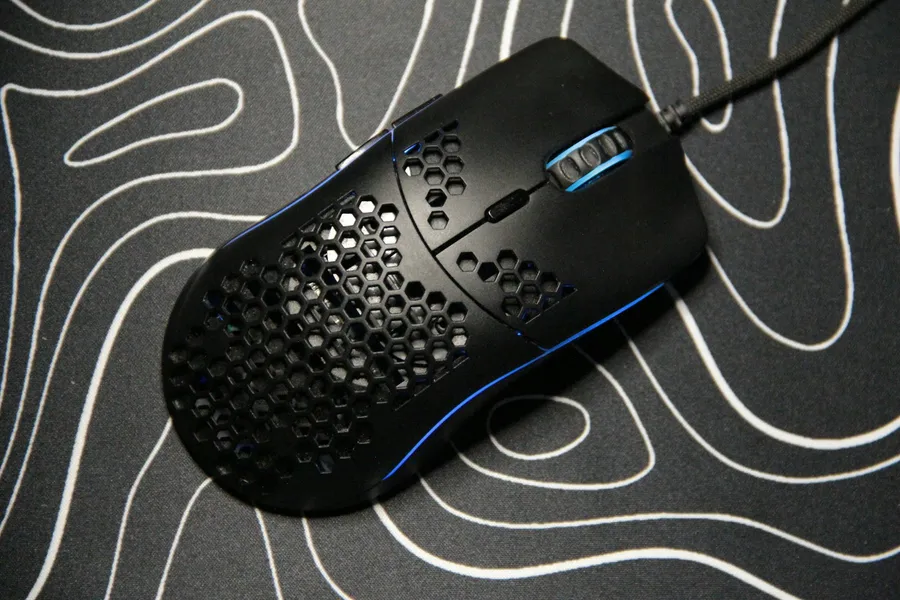
Why are gaming mice so expensive? Mostly not because of the sensor chip. The PixArt PAW3395, one of the most common gaming sensors, sits in mice from $22 to $299 in our catalog. The gap pays for a lighter shell, faster wireless and the brand, and for things a spec sheet barely shows: switches, coating, skates, battery, quality control and the work behind the shape.
Everything below comes from the US prices we track for 1,316 gaming mice. The typical one costs $69.
The same sensor costs $22 or $299
Most gaming mice use one of a few PixArt sensors. Counted by exact model, so the SE and Pro versions are left out:
| PixArt sensor | Mice | Cheapest | Typical | Priciest |
|---|---|---|---|---|
| PAW3311 | 106 | $9 | $33 | $99 |
| PAW3395 | 400 | $22 | $59 | $299 |
| PAW3950 | 337 | $33 | $80 | $300 |
Here are two PAW3395 mice of almost the same size, $154 apart:
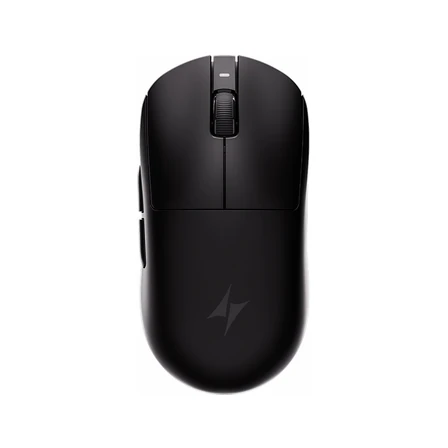
- Weight
- 57 g
- Size
- 125 × 64 × 40 mm
- Connection
- Wireless
Wireless at 8000 Hz, PAW3395, about $35.
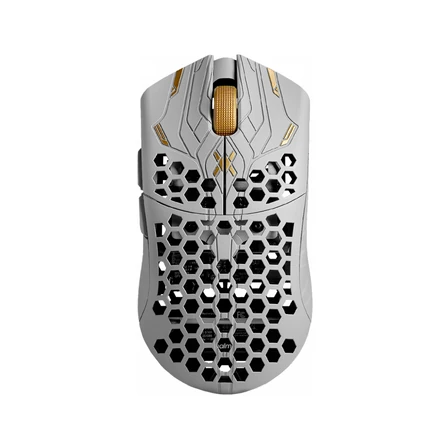
- Weight
- 38 g
- Size
- 126 × 65 × 38.4 mm
- Connection
- Wireless
Same sensor chip, the same 8000 Hz wireless, and the shell is within 1.6 mm of the ATK in every direction. The extra $154 buys 19 g: 38 g against 57 g, a difference you feel in every flick. You don't need a Finalmouse for that, though: 162 mice in our catalog weigh 40 g or less, from under $40.
Same sensor, not the same mouse
A shared chip doesn't make two mice track the same. The lens, the microcontroller and the firmware around the sensor can differ, and so can how closely the mouse hits the DPI you set. Viscose, who reviews mice and teaches aiming on YouTube, set his Endgame Gear OP1 and a Pwnage Trinity CF to the same DPI: My op1 measured at 1640 dpi while this measured at 1450. Where the sensor sits under the shell also changes how wrist movement feels, and no software setting moves it.
Click latency, the delay between a press and the computer seeing it, varies too, and some wireless mice beat wired ones. Lift-off distance and motion sync are now standard settings. Some brands set them in a desktop app, others in a web browser, which many players prefer.
Why are wireless gaming mice so expensive?
Wireless adds a battery, a radio and a receiver. That's about $15 at the median: $55 for wired-only gaming mice, $70 for wireless ones.
A faster polling rate adds more. Wireless mice that report 4000 times a second or more cost $80 at the median, against $50 for slower wireless ones. Part of that is the radio chip: Attack Shark says its 8000 Hz V8 uses Nordic's 54L15, with twice the core frequency of Nordic's older nRF52840.
You may not need it. Rocket Jump Ninja, who has reviewed mice for a decade, says 1K is stable, uses less battery, and is more than enough for gaming. Above that is a matter of taste: if you feel the difference, pay for it.
Light costs extra
Weight is where the price climbs fastest. Gaming mice under 50 g cost $90 at the median, against $60 between 50 and 90 g, where the price barely moves with the weight.
Taking grams out of a shell means thinner walls, holes or a different material. In our catalog 71 mice have carbon fiber shells and 54 metal ones, and both cost more to make than plastic.
The brand
Median prices in our catalog for some of the brands with at least eight gaming mice:
- PMM $195, Finalmouse $175, G-Wolves $147, WLMOUSE $143, Zowie $139, Pulsar $130
- Logitech $100, Razer $90, Corsair $90
- ATK $65, Attack Shark $58, Rapoo $50, Redragon $33, VXE $25
Part of that gap buys a longer warranty, steadier quality control or a local shop that takes returns. Part of it is just the name.
Where the rest of the money goes
The parts are the cheap bit. Price the main ones for a wireless PAW3395 mouse at component shops and you get roughly $25 to $45: about $12 to $15 for the sensor with its lens, $4 to $6 for a Nordic nRF52840 radio chip (and the same again in the dongle), 20 cents to a dollar per main switch, under a dollar for the scroll encoder and about $6 to $10 for a 500 mAh battery. A factory buying them by the hundred thousand pays less. Bought singly at retail, a switch costs about $1 and an encoder $2. What the parts leave out is the molds, the firmware, the radio certification, which Logitech told Kotaku costs tens of thousands of dollars in each country, the shipping and the shop's cut.
Logitech reports gross margin for the whole company rather than for gaming: 43.2% in its year to March 2026, when gaming brought in $1.41 billion of its sales. Research, marketing, software and staff all come out of that margin. Corsair's peripherals business ran at 39.4% in 2025. Razer reported 24% in 2021, its last full year as a listed company.
The shop adds its own cut. Best Buy's gross profit across its whole US business was 20.9% in its latest year.
Why are gaming mice so expensive now?
Tariffs are part of it. In April 2025 Logitech's finance chief told investors, "We don't like to raise prices, but we have to," and an analyst found about half of 176 Logitech products had gone up, mostly by 15 to 20%. The US Supreme Court struck those tariffs down in February 2026, and a 10% surcharge replaced them days later.
When an expensive mouse is worth it
When it buys something you'd notice, like less weight or no cable. Shape matters more than either: a $150 mouse that's too big for your hand is worse than a $40 one that fits. Measuring your hand takes a minute and gives you the length to look for.
The finder ranks mice by your hand and grip, and its budget slider shows how cheap you can go for a shape that fits. If the shape you like only comes from an expensive brand, look for a cheaper twin: many shells sell under several names, and our MX Master alternatives include a close match to the $100 MX Master 3S for about $43.
Questions
Are expensive gaming mice better?
Not for the sensor chip, which is often the same. You pay for less weight, wireless, the build and the brand, and the first two you feel straight away.
Is a $20 gaming mouse any good?
It can have the same sensor chip as a $150 one. Where cheap mice can differ is the build, the click latency, how accurately they hit the DPI you set, the software and the support if something breaks.
Sources
- Fiscal 2026 results (SEC filing)sec.gov
- Q4 2025 results and peripherals marginseekingalpha.com
- Full year 2021 resultsrazer.com
- Q4 fiscal 2026 earnings callmarketbeat.com
- Logitech raised prices because of tariffsvice.com
- Supreme Court invalidates IEEPA tariffsjonesday.com
- Attack Shark V8 announcement (PR Newswire)tools.prnewswire.com
- The cost of magnesium and carbon fiber mouse shellsattackshark.com
- PAW3395 sensor with LM19-LSI lens, retailaliexpress.com
- Nordic nRF52840 radio chiplcsc.com
- Omron D2FC-F-7N main switchlcsc.com
- Kailh GM 8.0 main switchaliexpress.com
- Kailh GM 8.0 micro switch, retailmechkeys.com
- ALPS EC10E scroll encoderlcsc.com
- Scroll wheel encoders, retailshop.facfox.com
- 500 mAh 503035 Li-po batterydigikey.com
- How Logitech spent millions on a gaming mouse (radio certification per country)kotaku.com
- This mouse should have been perfect (video): DPI measured 1640 vs 1450, low sensor positionyoutube.com
- Wired vs Wireless Gaming Mouse Latency (video): wireless mice beating wired on click latencyyoutube.com
- How To Choose A Gaming Mouse (video): 1K polling is more than enoughyoutube.com