Why does my hand hurt when I use a mouse?
Usually it's repetition, a tight grip, a bent wrist or long sessions without a break. Most of that you can change at your desk.

The usual answer to "why does my hand hurt when I use a mouse" is repetition: the same small movement, thousands of times a day. A tight grip, a wrist bent sideways or pressed on a hard edge, a mouse set too far away and long sessions without a break all add to it. Most of that you can change at your desk.
Tingling, numbness or weakness is a different matter. If you have any of those, see a doctor before you buy another mouse. This is not medical advice.
Fix the setup first
OSHA and Cornell's ergonomics lab agree on most of this:
- Keep the mouse close to the keyboard and at the same height, so your arm doesn't reach out or up.
- Keep your wrist straight, not bent up or to the side.
- Don't make every move by swiveling your wrist. Cornell suggests pivoting from the elbow. Matty, an aim trainer with Voltaic, says aiming takes the whole arm, from the fingers up to the shoulder, with short motions left to the wrist and fingertips.
- Hold it lightly. OSHA warns specifically against gripping it tightly to keep control.
- Don't rest your wrist on hard or sharp edges, the edge of the desk included.
- Take short breaks to stretch.
Wrist rests are where the two part ways. OSHA suggests a mouse pad with a wrist or palm rest to keep your wrist neutral. Cornell advises against them, saying research shows a wrist rest doubles the pressure inside the carpal tunnel. Either way, a rest won't make up for a bad setup.
What aim coaches say about grip and pain
Aim coaches start with grip pressure. MiniGod, a Voltaic aim coach, tells players to think of your mouse as an egg. Some tension is needed to move fast and stop, but Viscose, who teaches aiming on YouTube, calls excessive fingertip tension a habit to break, partly for your hand's health.
Nor do they treat pain as part of training. Viscose says holding a mouse isn't meant to be painful, and if a grip hurts, he suggests other grips first, then a mouse that suits your hand. Matty nearly quit over wrist pain. A physiotherapist from the 1HP service, speaking in his video, traces it to poor overall endurance of the forearm muscles responsible for clicking and to his schedule. Endurance work, a planned training schedule and a daily routine fixed it; a new mouse is not part of the fix. CartoonFPS, an Aim Lab community champion who coaches aim, hurt his wrist, elbow and neck training over four hours a day straight and now breaks every 30 to 60 minutes.
That's players' experience, not a treatment plan. If the pain stays, see the doctor section below.
A mouse that doesn't fit your hand
OSHA and Cornell both say to choose a mouse that fits the hand using it, and a 2004 study found that hand size and where you hold the mouse both changed how hard the forearm and hand muscles worked.
Viscose found his heavy G502 too big to claw and too heavy to move with his fingers, which kept him in a palm grip. If your natural grip feels strained, check the size. Measure your hand from the wrist crease to the tip of your middle finger and compare your mouse with the chart in that article. If your grip has drifted, claw vs palm grip explains what each grip needs from a shape. Or give the finder your hand size and grip for a shortlist of shapes to try, ergonomic and vertical ones included.
Why your hand hurts when you use a mouse
Using a mouse can cause hand pain. The NHS calls pain from repeated movement repetitive strain injury, or RSI, with symptoms such as burning, aching, stiffness, tingling and cramps. Cleveland Clinic lists people who use a computer often among those at risk, and names tendinitis, carpal tunnel syndrome and trigger finger among the conditions RSI can lead to.
Carpal tunnel is the one people worry about, and the evidence is weaker than its reputation. MedlinePlus says studies have not proved that typing or using a mouse causes it. The same activities can inflame the tendons in the hand, though, which narrows the space the nerve runs through.
When to see a doctor
The NHS says to see a doctor if you have tingling or loss of feeling in your hand or wrist, or if the pain isn't going away or keeps getting worse. Losing feeling in part of your hand, or being unable to move your wrist or hold things, counts as urgent. MedlinePlus adds dropping things and getting clumsier with that hand. Mention it, too, if pain or tingling wakes you at night: the NHS and Cleveland Clinic both describe carpal tunnel symptoms as typically worse then.
Do vertical or ergonomic mice help?
A 2015 study of 12 people found that angled mice reduce how much you twist your forearm with no loss in pointing performance, while the fully vertical one pointed worst of the group. That was a click test, not a game, so for gaming, keep your usual mouse and use the vertical one for work.
Whether less twisting means less pain is another question. A 2018 Cochrane review of 15 studies found hand and arm problems were not much lower with an alternative mouse than with a conventional one, based on moderate-quality evidence. Cornell advises a mouse as flat as possible. Logitech's claim that the MX Vertical cuts muscle strain by 10 percent is its own figure.
A vertical mouse may still feel better to you, but you won't know until you've used one for a while, so try a cheap one, in your size, before you pay $80 or more.
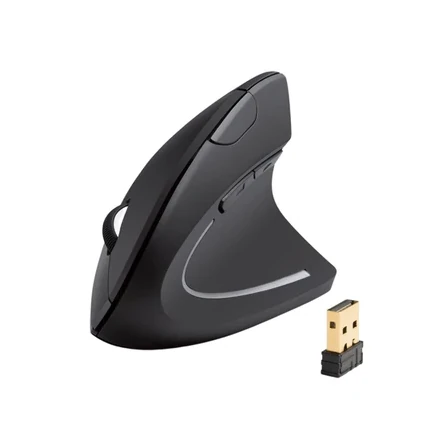
- Weight
- 96 g
- Size
- 120 × 62.8 × 74.8 mm
- Connection
- Wireless
The cheap way to find out whether a vertical mouse suits you, at about $30. It's as long as the MX Vertical and 39 g lighter, and it only connects through its receiver.
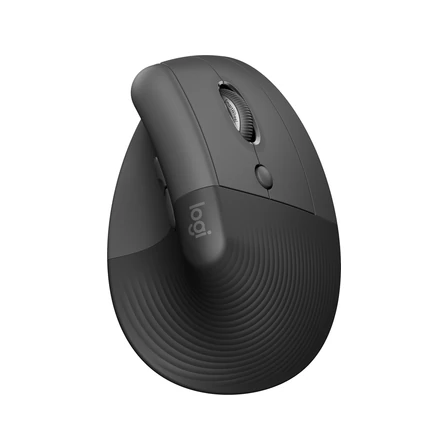
- Weight
- 125 g
- Size
- 108 × 70 × 71 mm
- Connection
- Wireless
Logitech sells the Lift for small to medium hands. It's 12 mm shorter than the MX Vertical at the same 57° angle, and the only one of these three with a left-handed version.
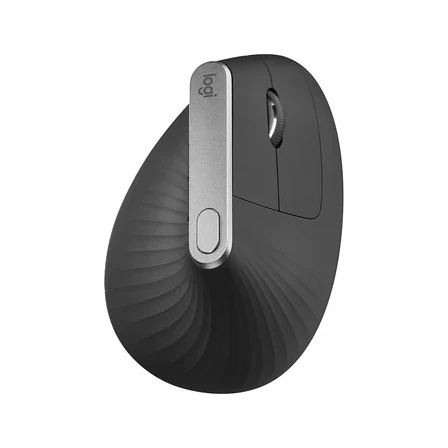
- Weight
- 135 g
- Size
- 120 × 75.5 × 79 mm
- Connection
- Wireless
At about $120 this costs four times as much as the Anker, so buy it once a cheaper vertical mouse has shown you the shape helps. Logitech pitches it at medium to big hands.
Questions
Can a mouse cause carpal tunnel syndrome?
It hasn't been proven, but numbness or tingling in your fingers is worth a doctor's visit either way.
Why does my hand hurt from clicking the mouse?
Clicking is the kind of small, repeated movement the NHS links to RSI. Hold the mouse lightly, take breaks, and check that you can reach the buttons without stretching.
Is a vertical mouse better for wrist pain?
It reduces forearm twisting, but the Cochrane review found little difference in hand and arm problems. If your forearm feels twisted on a normal mouse, try a cheap one in your size first.
What kind of mouse is best for hand pain?
One that fits your hand and is comfortable in your natural grip, held lightly, on the setup above. In the Cochrane review a different shape alone made little difference, so treat a new mouse as one step alongside grip, setup and breaks.
Sources
- Repetitive strain injury (RSI)nhs.uk
- Wrist pain and when to get helpnhs.uk
- Carpal tunnel syndromemedlineplus.gov
- Carpal tunnel syndromenhs.uk
- Carpal tunnel syndromemy.clevelandclinic.org
- Repetitive strain injurymy.clevelandclinic.org
- Computer workstations, pointer and mouseosha.gov
- Mouse tipsergo.human.cornell.edu
- Ergonomic interventions for computer users (Hoe et al., 2018)cochrane.org
- Angled mice and forearm rotationpubmed.ncbi.nlm.nih.gov
- Hand size and muscle activity on a mousestacks.cdc.gov
- Lift vertical ergonomic mouselogitech.com
- MX Verticallogitech.com
- All Your Aim Training Questions Answered (video)youtube.com
- How to find your aiming mouse (video)youtube.com
- Wrist Pain Nearly Ended My Aim Career (video)youtube.com
- Killing Aim Myths (video)youtube.com
- Is your mouse grip holding you back? (video)youtube.com
- Tension Management Guide (video)youtube.com
- In Spanish (video)youtube.com